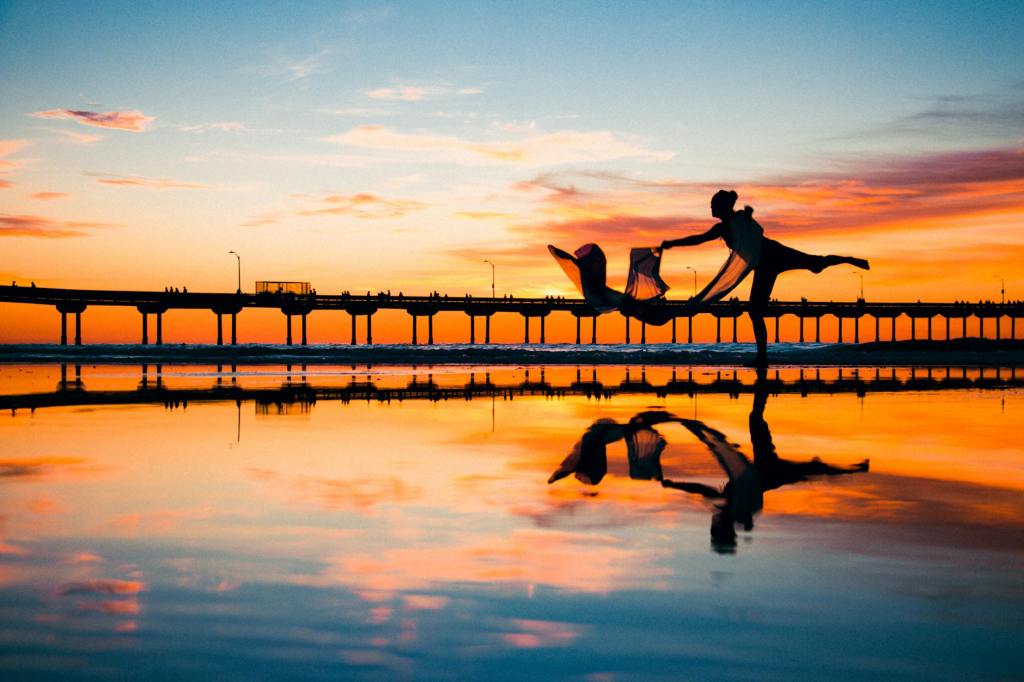
WHEN DID YOU STOP DANCING?
A young girl around the age of 11 walks to the elementary school a block away. It is early evening. Her mom is still at work and will not be home for another hour or two. She is bored and lonely, although at the time she does not recognize these two emotions. She tracks down her friend, Norm, the school janitor, a grandpa who kids are safe with. Norm welcomes the neighborhood kids to join him as he cleans the classrooms. These classrooms are situated in a quad setting. Four rooms surround two restrooms in the center. On this day, no other kids were around. Norm plays music on the overhead speakers, moves the student tables and chairs to the back of the room so he can mop later, then leaves to tend to the other rooms. The girl, wearing a knit scarf, closes her eyes and begins to dance to the music, using the scarf as her companion or prop. She twirls, chasses, plies, jumps, and takes up the full space of the room. A married couple walking the school grounds after work, stop in front of the large classroom window, and watches the girl dance. They smile. The girl imagines herself to be a famous ballerina, but pretends not to see the couple, otherwise she would feel obligated to stop. She does not want to stop for anyone or anything.
Same girl; different day. Her best friend, Julie, joins her at home. Inside the front door, the entryway is a small landing and to the right is a sunken living room. Straight ahead is a closet and hallway. To the left is a set of three mirrors along the wall. This entryway landing makes for a perfect stage. The girls choreograph dances to Sean Cassidy’s ‘Da Do Ron Ron’ and ‘Hey Deanie’, Leif Garrett’s “I was Made For Dancing”, and others. As soon as they feel ready to perform, they gather their parents and siblings, and turn around, away from the mirrors, to dance for their family in the living room. They twirl, chasses, plies, jump, and take up the full space of the landing. They dance until they are sweaty and take a snack break of popcorn and pepsi.
Same girl; junior high. School dance. Regardless of how fast or how slow the music is, everyone slow dances. Her friend, Tim, with a gleam in his eye, gets her on the dance floor, and breaks a move. Not a slow dance move, but fun, fast, dance moves, with twirls, chasses, plies, and jumps, taking up the full space of the gymnasium. The girl giggles in delight, but starts to look around and hopes that he is not drawing too much attention to them.
Same girl; college. She pledges a sorority and she and her sisters are preparing choreographed dances and skits for Rush, the annual recruitment tradition. Dancing the same dance with 40 other young women, she feels like she belongs to something bigger than herself and there is a comfort and security in feeling like she fits in. But these moves are different. More restricted. Everything has to be uniform and precise. No opportunity for her personal stamp. Everyone has their own small square with which to move. The dance serves a purpose. There is an agenda. Attract and recruit. She stays in the middle of the group. All wearing the same white shorts with green tees, ponytails with bows, and smiles, smiles, smiles!
A few post college nightclub nights. The girl feels out of place and hates the attention she receives from men yet at the same time yearns for said attention. After a few times out, she stops going… and stops dancing.
Fast forward twenty five years, the girl attends a book club that focuses on personal growth, recovery, and transformation. She reads, “the brain cannot have anxiety and learn something new at the same time. So, go out, and learn something new, like country line dancing.” And that is exactly what she does. In front of her TV, she Tush-Pushes, Boot Scootin’ Boogies, Slaps Leather, and Cowgirl’s Twist. She dances until she is sweaty, takes a break with sparkling water and lime, and smiles, smiles, smiles.
 Writings of Recovery
Leave a comment